

Whipple Surgery Cost in India
Last updated: April 25, 2026
Starting from USD 14,000
Whipple Surgery Cost in India starts from US $7,500 and varies depending on your medical condition and history, technique used for the surgery, surgeon, hospital and the city where you choose to get the procedure done.
INCLUDES
- Surgery
- Stay at the Hospital
- Pre-operative Investigations
- Medicines, Consumables
- Food at the hospital
- Airport Transfers
- MediTraWell assistance
DOES NOT INCLUDE
- Accommodation outside the Hospital
- Air tickets
- Medical Visa fee
STAY REQUIRED
- Stay at the Hospital - 1 to 2 days
- Stay at the Hotel - 7 to 8 days
- Stay in India - 8 to 10 days
Whether you choose one visit for your Gastroenterology tourism in India or would require to visit again, IndiCure will make sure your trip is seamless and hassle-free. Our team of dental clinics and dental surgeons offer nothing but the best in class care using the top notch technology. We vow to be with you every step of the way practicing our old age Indian custom of Atithi Devo Bhava! (the guest is God)
Factors that affect Whipple Surgery Cost in India
- Surgical Technique
There are different techniques to perform whipple surgery- open, laparoscopic and robotic. Your surgeon would advise the best technique for you depending on your medical history and health condition. The cost varies to a great extent on the technique through which the surgery is performed.
- Surgeon’s Fees
An important expense when it comes to your whipple surgery in India is going to be your surgeon’s fees. IndiCure recommends highly experienced, skilled, board-certified surgeons who are capable of delivering successful surgeries. Although the charges may vary depending on the experience of the surgeon, you can be assured that you are in safe and skilled hands when you choose cancer treatment in India with IndiCure.
- Surgical Facility
Having your whipple surgery done in an accredited surgical facility by skilled and qualified medical staff is a critical factor. Moreover, the geographical location of this facility in India also affects the quote. But, IndiCure provides you with a projected estimate that will be all inclusive and affordable.
- Pre and Post Treatment Expenses
The pre-surgical/treatment expenses are associated with the stage of the cancer and medical condition of the patient and thus the number and type of investigations and treatment required. Post-treatment expenses may include prescription medications and follow-up consultations.
We at MediTraWell, understand that you travel with a budget in mind and do not like to be greeted by surprises after arrival in India. We thus club all these expenses and give you a package cost that is inclusive and affordable at the same time.
Your case manager shall give you an estimated cost of your surgery after discussing your medical reports with the surgeon. The final cost, however, shall be confirmed after your consultation with the surgeon.
Medi Trawell Services
Making Medical Travel to India Affordable & Hassle-free for 15+ Years

We Help you Choose the Right Treatment, Surgeon & Hospital

We Arrange Video/Telephonic Consultation with the Surgeon

We Assist you with Visa & Accommodation

We Receive you at the Airport and Drop you at Hotel/Hospital

We Assist you the at Hospital & Provide Post Operative Support
Our services are FREE for our patients.
In fact, we have Special Negotiated Rates with the Hospitals and you can avail Discounted Rates when you choose to Travel with MediTrawell. Container
Best Gastroenterologists in India
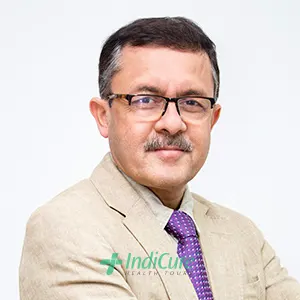
Dr. Amit Maydeo
Medical Gastroenterologist
MBBS, MS, FASGE (Fellow of American Society for GI Endoscopy)
Mumbai
Dr. Amit Maydeo is a gastroenterologist and endoscopy expert who is most known for his work on therapeutic endoscopy and endoscopic retrograde cholangiopancreatography (ERCP). In 2013, the Indian government honored him by awarding him the Padma Shri, the country’s fourth highest civilian honor, for his services to medicine and medical education.
In 2013, the Indian government honored him by awarding him the Padma Shri, the country’s fourth highest civilian honor, for his services to medicine and medical education
Endoscopy, small and big bowel surgery, laparoscopic surgery, gastroscopy, and treatment of various gastrointestinal diseases such as gastritis are the areas of his expertise.
He has many firsts to his credit. He pioneered and introduced several new procedures and kinds of technology for the first time in India. He introduced India’s first Video-endoscopy device, which allows doctors to see the inside of the gastrointestinal tract with exceptional clarity and high picture resolution. Along with experts from the Indian Institute of Chemical Technology, he created the first Indian Cyanoacrylate Glue. He was able to treat individuals with life-threatening bleeding esophageal veins caused by liver cirrhosis as a result of this. The first Spyglass cholangioscopy apparatus was introduced in India for the diagnosis and treatment of biliary and pancreatic problems by him. He was the first to introduce the POEM method for the treatment of achalasia cardia.
He introduced India’s first Video-endoscopy device
created the first Indian Cyanoacrylate Glue. He was able to treat individuals with life-threatening bleeding esophageal veins caused by liver cirrhosis as a result of this
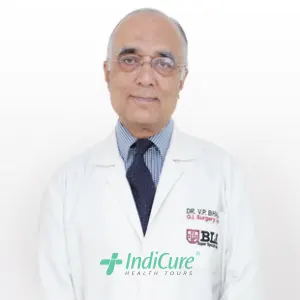
Dr. V P Bhalla
Surgical Gastroenterologist
MBBS, MS, Fellowship, UK
New Delhi
Dr. Bhalla is a renowned surgical gastroenterologist in India with more than 42 years of experience. He is an expert in the treatment of peptic and gastric ulcers, gastroenteritis, acidity, gallbladder (biliary) stones, hepatitis, liver disease, malabsorption, pancreatitis, and other conditions related to the liver and the gastrointestinal tract.
Hepatobiliary Pancreatic Association, the Indian Association of Surgical Gastroenterology, the Society for Surgery of the Alimentary Tract in the United States, the Society for Surgery of the Alimentary Tract in the United Kingdom, and the Editorial Board of the Journal of Clinical -Diagnostic Research
He is a member of numerous prestigious organizations, including the International Hepatobiliary Pancreatic Association, the Indian Association of Surgical Gastroenterology, the Society for Surgery of the Alimentary Tract in the United States, the Society for Surgery of the Alimentary Tract in the United Kingdom, and the Editorial Board of the Journal of Clinical -Diagnostic Research.
He did his Fellowship from St. Marks Hospital for Coloproctology and is a Fellow of the International College of Surgeons, London, United Kingdom. He has also done advanced training for liver transplantation at Kaohsiung Memorial Hospital in Taiwan.

Dr. Vinay Dhir
Medical Gastroenterologist
MBBS, MD, DNB, Fellowships
Mumbai
Dr. Vinay Dhir is a skilled medical gastroenterologist in India with nearly 32 years of expertise in the field. He is an esteemed participant in a number of associations, including the Indian Society of Gastroenterology and the Society of Gastrointestinal Endoscopy of India. He is also a member of the American Society of Gastrointestinal Endoscopy.
He is also a member of the American Society of Gastrointestinal Endoscopy
After completing his MBBS, he went on to complete his DNB in gastroenterology at the prestigious Tata Memorial Hospital and his MD in internal medicine at MGM Medical College in Indore. Additionally, Dr. Dhir has training in Endo-Sonography from the Academic Medical Centre in Amsterdam and a Fellowship in Therapeutic ERCP from the European Gastro Surgical School in Amsterdam.
He has received numerous honors in the field of gastroenterology (endoscopy), including the ASGE Audiovisual Award (2015) and the Digestive Endoscopy Best Reviewer Award (2012).
Additionally, Dr. Dhir has training in Endo-Sonography from the Academic Medical Centre in Amsterdam and a Fellowship in Therapeutic ERCP from the European Gastro Surgical School in Amsterdam
In addition to serving as teaching for numerous worldwide interventional endoscopy courses, he has several highly referenced works in indexed international journals.
Best Gastroenterology Hospitals in India
Manipal Hospital, (Formerly Columbia Asia Hospital), Yeshwanthpur, Bangalore
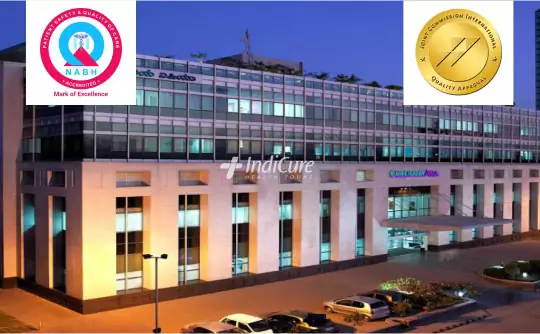
Location: Bangalore
Speciality: Multi-Superspeciality
Accreditation: Accreditation : JCI, NABH
No. of Beds: Beds : 250
Columbia Asia, Yeshwanthpur is a NABH accredited super-specialty hospital located in upmarket Yeshwanthpur in Bangalore. It started its operations in July 2008. It is a multi super-specialty hospital located in upmarket Yeshwanthpur in Bangalore. It is the flagship hospital of the group and is both JCI and NABH accredited. Having started its operations in 2008, the hospital has already made its mark to be listed among the top hospitals in India. Columbia Asia Yeshwanthpur has the best in class infrastructure, backed by cutting-edge technology and a vast pool of skilled and experienced medical and support staff.
Dr. LH Hiranandani Hospital, Powai, Mumbai

Location: Mumbai
Speciality: Multi-Superspeciality
Accreditation: Accreditation : NABH, NABL
No. of Beds: Beds : 240
Dr. L H Hiranandani hospital was founded in honor of the legend, Padma Bhushan Dr. Hiranandani, and came into existence in February 2004. Within 3 years, viz 2007, it became the first hospital in Western India to receive NABH accreditation, which only eight hospitals in India had received then. The hospital offers all medical and diagnostic facilities under one roof and is counted among the best hospitals in Mumbai. Not only accreditation, but the hospital also has the rare honor to receive the IMC Ramkrishna Bajaj National Quality Award trophy, for excellence in healthcare in 2008. In 2009, Hiranandani hospital received the coveted International Asia Pacific Quality Award (The Malcolm Baldridge Award) as it is known outside the United States. Within 3 years, viz 2007, it became the first hospital in Western India to receive NABH accreditation, which only eight hospitals in India had received then.
Whipple Surgery
Whipple procedure, also known as a pancreaticoduodenectomy, is a complex operation to remove the head of the pancreas, the first part of the small intestine (duodenum), the gallbladder and the bile duct.
The Whipple procedure is used to treat tumors and other disorders of the pancreas, intestine and bile duct. It is the most often used surgery to treat pancreatic cancer that’s confined to the head of the pancreas. After performing the Whipple procedure, your surgeon reconnects the remaining organs to allow you to digest food normally after surgery.
A Whipple procedure may be a treatment option for people whose pancreas, duodenum or bile duct is affected by cancer or other disorder. The pancreas is a vital organ that lies in the upper abdomen, behind your stomach. It works closely with the liver and ducts that carry bile. The pancreas releases (secretes) enzymes that help you digest food, especially fats and protein. The pancreas also secretes hormones that help manage your blood sugar.
The goal of doing a Whipple procedure for cancer is to remove the tumor and prevent it from growing and spreading to other organs. This is the only treatment that can lead to prolonged survival and cure for most of these tumors.
The Whipple surgical procedure can be performed in three different ways.
- Open Surgery – An open surgery is performed by the surgeon making an incision in the abdomen to access the pancreas. Open surgery is the most commonly performed and most extensively studied version of Whipple surgery.
- Laparoscopic Surgery – Laparoscopic surgery is a minimally invasive version of the Whipple procedure. A small incision is made in the abdomen and special instruments are inserted. These small instruments include a camera that will send videos to a monitor to guide the surgeon during the procedure.
- Robotic Surgery – Robotic surgery is a minimally invasive surgery during which surgical tools, attached to a robot, are inserted into small incisions in the abdomen. The surgeon uses video to observe the organs and controls the robotic arms from a console. The benefit of this form of surgery is that the small robotic arms can access areas and make small adjustments that are not possible with human hands.
While the minimally invasive surgical options come with less risk of blood loss and infection and a quicker recovery time there are also some drawbacks.
Laparoscopic and robotic surgeries both take longer to perform than an open surgery which is harder on the body. There is also the risk that there will be complications during a minimally invasive procedure that require the surgeon to switch to open surgery to finish the procedure.
When is Whipple Surgery needed?
Your doctor may recommend you have a Whipple procedure to treat:
- Pancreatic cancer
- Pancreatic cysts
- Pancreatic tumors
- Pancreatitis
- Ampullary cancer
- Bile duct cancer
- Neuroendocrine tumors
- Small bowel cancer
- Trauma to the pancreas or small intestine
- Other tumors or disorders involving the pancreas, duodenum or bile ducts
Questions to Ask
We at IndiCure completely understand your concerns and it is always our endeavor to provide the best outcome for every patient. Following is the list of questions you must ask before you embark on your journey for whipple surgery in India.
- Is it time for whipple surgery?
- Is the oncologist board certified?
- How experienced is the Surgeon?
- Which language does the surgeon speak?
- Is the treatment done in a well-equipped facility?
- What cancer treatment option is recommended for me?
- What about the risks involved?
- Does the surgeon use a certified anesthetist?
- How long will the recovery period be?
Preparation for the Surgery
Prepare to answer questions about your:
- Medical history and exams
- Previous surgeries
- Current medication review
- History of smoking, drugs, or alcohol
How is Whipple Surgery done?
Step 1: The surgeon makes an incision in your abdomen to access your internal organs. The location and size of your incision varies according to your surgeon’s approach and your particular situation.
Step 2: For a Whipple procedure, the head of the pancreas, the beginning of the small intestine (duodenum), the gallbladder and the bile duct are removed.
In certain situations, the Whipple procedure may also involve removing a portion of the stomach or the nearby lymph nodes. Other types of pancreatic operations also may be performed, depending on your situation.
Step 3: Your surgeon then reconnects the remaining parts of your pancreas, stomach and intestines to allow you to digest food normally.
What Results can I Expect from Whipple Surgery?
Your chances of long-term survival after a Whipple procedure depend on your particular situation. For most tumors and cancers of the pancreas, the Whipple procedure is the only known cure.
What is the Recovery after Whipple Surgery like?
After discharge from the hospital, most people can return directly home to continue recovery. Some people are asked to stay nearby for several days for monitoring and follow-up visits. Older adults and people with significant health concerns may require a temporary stay in a skilled rehabilitation facility. Talk to your surgeon and team if you are concerned about your home recovery.
Most people are able to return to their usual activities four to six weeks after surgery. How long it takes you to recover may depend on your physical condition before your surgery and the complexity of your operation.